Posts

Future Tense (2 Points)

The year is 2220. Humanity has, in essence, created immortality. When the body dies, an AI copy of the consciousness can be created and can live on through virtual reality. Some people use this to continue to interact with dead loved ones, and others meet AI versions of their idols. There has been a lot of debate over how legitimate these AI copies are considering they are created by humans. No matter how hard they try, the people who create these do have biases. This is especially true when the family is involved in crafting the AI version of their dead relative; is this a truly authentic version of the person, or an idealized version? How does this affect their legacy? In the end, does it really matter as long as the family is happy? The morality of turning this into an industry would be questioned, but capitalism was abolished after The Millennium War in 2100, so it’s no issue. VR has blown up in popularity after scientists figured out how to simulate the sens...

Final Blog

Readings: 76 Movies: 18 Attendance: 13 Future Tense Activity: 2 Total points: 109

The Hitchhiker's Guide to the Galaxy Fits 1 & 2 (1 Point)

 Oh man this is so refreshing. It’s so nice to listen to something so fun and lighthearted in 2020 considering, well, everything. The Hitchhiker’s Guide to the Galaxy combines the imagination and adventure of classic science fiction with the goofy comedy and biting satire of 80s/90s era British sketch comedy like A Bit of Fry and Laurie . I love how Adams mines comedy from exposition, which can be dry and boring. As a matter of fact, Adams weaponizes the dryness of exposition; the way characters say such ridiculous things so matter-of-factly makes up a good amount of the humor. It never gets old because Adams seemingly has a bottomless hat to pull creative and hilarious ideas from. There’s a fun irony to Adams establishing that Earth isn’t special (mostly harmless) while also applying Earthly concepts to his expansive universe. For example, the reason Earth is destroyed is to make way for a byline, just like how Arthur’s house was to be demolished to make way for a byline. Does th...

Bloodchild (2 Points)

1. What is your reaction to the text you just read?  That was…a lot. There’s a lot to unpack with the relationship between the Tlic and the Terrans. It’s disgusting in a literal sense, but it also mirrors a lot of things going on in the real world. Their parasitic relationship, which the Tlic make out to seem mutually beneficial, reminds me of how some white people view Black people. In America, the whites are the ruling race, like the Tlic in the Preserve. They make it seems like Black people are just part of the “mutually beneficial” system of capitalism, but really, they are an oppressed class, being used to further the wealth of those in charge. This parallels how the Tlic use the Terrans as host bodies for their young, but make it seem like they’re doing the Terrans a favor by “protecting” them, when in reality they are putting them in harm’s way.  2. What connections did you make with the story? Discuss what elements of the story with which you were able to connect?...

Metropolis (2 Points)

A lot of Metropolis barely feels like fiction at this point, at least when it comes to its commentary on society. As a matter of fact, it weirdly feels like a predecessor to Bong Joon-Ho’s Parasite. Both visually portray class in similar ways; the working class literally live under the upper-class, who don’t really care about those beneath them. Sure, you can argue it’s a bit of an obvious visual metaphor, but I don’t think it takes away from how effective it is. I’d argue that some of the most powerful imagery seems obvious. It speaks to the core of what it’s representing, in this case how the working class is seen as below the upper class. It’s kind of hard to analyze it beyond that, because the film sums it up better than I could with its final card: “The Mediator Between the Head and the Hands Must Be the Heart.”

I Have No Mouth and I Must Scream (1 Point)

Image
I Have No Mouth and I Must Scream is the evil A.I. story to end all evil A.I. stories. AM is a being of pure hatred who takes glee in psychological and physical torture. I have to give it to AM, he is creative in his torture; if you’re gonna be evil, might as well go all out. He’s the personification of cynicism and nihilism towards humanity. A being who saw both the best and worst of humanity and decided our best wasn’t even close to good enough.  We tend to think of advanced A.I. as overly rational, but I find that AM is closer to what a truly sentient A.I. can be. If it’s supposed to be so human, why would it be rational? Because it’s smart? Even the smartest of us give in to emotion. Our emotions and irrationality are what really make us human in the abstract sense. I wonder, is AM aware of how evil he is? Is he aware of the hypocrisy and just doesn’t care, or does he see it as a necessary evil? Or is he like Ted, the narrator, who sees himself as the best of them despite be...

Babel-17 (5 Points)

I really love how counterculture is portrayed in Babel-17. The book almost presents transhumanist elements as something that’s inevitable. Like, of course people who don’t fit in will give themselves giant fangs or fleshy wings; we already pierce our skin and give ourselves horns, so it’s not like we’re far off. It really taps into that idea that some members of marginalized groups say “fuck it, if society’s going to put us down for being ourselves, we might as well give in to our wildest ideas.” It’s kind of a fun part of not being a part of the mainstream, right? Just being able to go nuts and have fun with your appearance and having that be accepted. I think that’s what the book really conveyed to me through its descriptions; a sense of fun and playfulness with self-image. I feel like that’s elevated when these people with out-there body mods are juxtaposed with the customs officer who’s put off by them. Basically, it’s like putting some weird people next to a narc and saying “do y...

Ship's Boy (5 Points)

Ship’s Boy is very obviously a story about being part of a marginalized group. More than that, it’s about being a marginalized person and still being undervalued even once you’ve proven that you’re far more capable than people think you are. There’s an exchange that illustrates this perfectly. At this point, David is essentially being asked to go on a suicide mission to save the ship from an enemy attack. The captain, after clarifying this, goes on to praise him for how brave and competent he is, telling him that the House of Marcus will make sure he’s well cared for. Then David says that all he wants to do is be a ship’s engineer. The captain laughs this off and says that he’ll try to pull some strings if they survive. He then says, “A Rabbit as a ship’s engineer? David, you simply must be reasonable about certain things!” Even after all the praise, even after he’s proven how intelligent and brave he is, the captain still sees him as just a Rabbit.   The saddest thing is whe...

This Island Earth (1 Point)

Image
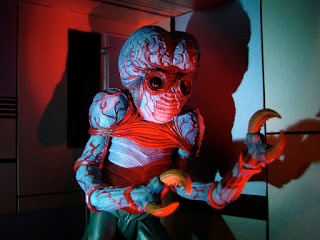
                 First thing’s first: Cal Meacham’s voice is insanely deep. It has to be all ADR, right? Because like…Jesus Christ.               Anyways, I hate to go full Undiagnosed-ADHD-Zoomer in this post, but I found This Island Earth kind of boring until the last half hour. I wanted to like this one, I really did, but I just couldn’t really get into it until they left Earth. I do love the film on an aesthetic level though. I’ve always been a sucker for clean retro sci-fi props and sets, and this movie delivers on that front. The interocitor’s design is great in its simplicity (although it’s kind of funny with hindsight that it’s essentially a big cell phone), and I appreciate how it explains how the gravity in their spaceship works. The Metaluna set has some really cool architecture and its limitations (by today’s standards) are charming. I really l...

Forbidden Planet (1 Point)

Image
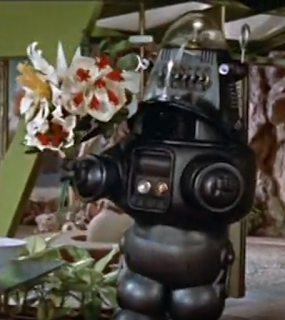
                      Forbidden Planet is a really interesting movie. It’s a clear progenitor of many aesthetic elements that would permeate throughout sci-fi movies. Sometimes historically significant movies like this can be a bit of a slog to watch; they can come off as predictable and tropey because so many of its elements have been done to death. However, I didn’t find that to be an issue with Forbidden Planet . Aside from the sexist elements, the familiar elements are charming and somewhat comforting. Granted, that could be personal bias since I grew up more of a sci-fi fan than a horror or fantasy fan (although I’ve fallen hard for horror and its many sub-genres). Something that this film does that I love is combining sci-fi elements with psychological elements. It’s kind of a psychological horror set in space and has more in common with films like Ex Machina than Star Wars . The way it incorporates Freudian elemen...

Lady in the Water (1 point)

             I have a confession to make: I’ve seen this movie once before. I saw it once when I was very young, but I had no idea what was going on in the movie. Since then I'd seen many a review and analysis since, and still barely understood what happened in the movie. So, now I’ve seen Lady in the Water in over a decade and I’m still not quite sure what I saw. I think I just witnessed M. Night Shyamalan have a mental breakdown in movie form? This is genuinely one of the most fascinating movies I’ve ever seen in my life. I feel so bad for his daughters who he wrote this as a bedtime story for. Imagine being a little girl and hearing this insane story read to you before bed.              Almost nothing works how I assume Shyamalan intended it to and it results in a nightmare that I just can’t look away from. It's amazing how nothing and everything is happening at the same time. I think Shya...

Troll Bridge (1 points)

  I’ve waited far too long to read Terry Pratchett. I’d meant to for a while, but there’s a lot of stuff I’ve been meaning to read, or watch, or play, or listen to. I guess I’d just been intimidated; I knew Pratchett’s Discworld series was legendary and big, so I just didn’t quite know where to start. I don’t know if Troll Bridge is part of that universe, but nonetheless it was a great taste of Pratchett’s work. In just seven pages, Pratchett was able to pack loads of charm and humor alongside a tinge of melancholy. The feeling of yearning for how things used to be is palpable in this story, and not just because it’s explicitly stated by the characters. It’s the way they talk about how things are that remind me of my own feelings of nostalgia for a time long gone. But really, it’s just how we perceive things, isn’t it? Cohen and Mica long for the world they went to war for, a feeling that real veterans express when they see the world today (both the left-leaning ...

Stardust (1 point)

  Stardust is a film that deconstructs superficiality and people’s obsession with their image or status. All of the characters who go after Yvaine want to use her to change something surface level about themselves: Tristan wants to win the affection of a girl who doesn’t truly love him back, Septimus wants to be an immortal king, and Lamia wants to look young again. Septimus and Lamia obsess over their status/appearance and don’t get their wishes granted. Tristan, however, learns that he shouldn’t obsess over a shallow woman who doesn’t love her back after meeting Captain Shakespeare, a man who, although also preoccupied with his appearance, still lets himself be, well, himself, even if it’s behind closed doors. Shakespeare never compromises his morals for his appearance. He later realizes he doesn’t need to keep up his manly charade to have the respect of his crew; they always knew he was a feminine flamboyant man (in other words: very gay coded) and they’ve st...

Midterm Post

Points from reading: 61 Points from movies: 12 Points from attendance: 6 (1 class missed) Total points: 79

Pan's Labyrinth (2 Points)

     Pan’s Labyrinth is Guillermo Del Toro’s masterpiece. Even though he made films after, it feels like the culmination of all his growth as an artist and thematic intentions up to that point. It’s a perfect modern fairy tale, integrating classic tropes with modern ideas. This mix of old and new is perfectly showcased by the standout creature of the film: The Pale Man.                  God what a great creature design. Aside from just being creepy, it communicates so much in its design. The Pale Man is supposed to be a gluttonous creature that represents the evils of the men in charge. The fact that his eyes are on his hands shows how materialistic these men are; they only see what’s right in front of them, not caring about the abstract, unless that abstract is power. He has bony and almost useless legs because he’s not used to having to move so much. He usually just gets to eat the child right then and there at the ta...

The City of Lost Children (2 points)

  The City of Lost Children shows us a nightmarish reflection of our own world. Nightmarish is a very appropriate term considering how important dreams are in the film.  One of the central characters of the film is a man who steals dreams from children to slow down his aging. I see this as a reflection of how society breaks us down at an early age, making us abandon our dreams to keep the system from falling apart. This is a system, of course, that only benefits those in power. How many of us wanted to be astronauts, or something fantastic like that, but gave up on that dream because of school, or work, or money? That’s what this film makes literal. Children are forced to bring money to their teacher if they don’t want to be punished. It’s an exaggeration of how regular children aren’t allowed to enjoy their childhoods because of capitalism and similar systems. I hate how relevant that feels during this pandemic.  

My Life in the Bush of Ghosts (5 points)

       The most striking thing to me about My Life in the Bush of Ghosts is the language. Amos Tutuola writes these strangely structured sentences that took me a while to get used to. There were points where I had to go back and reread sentences to get what was being said. I resisted the temptation to just say that it was poorly written and asked myself why he chose to write in this way. There was very clearly a method to the madness; many sentences were structured in a similar way. A common thing Tutuola did was start a sentence with "but" and then continue the sentence in a way that didn't require it to start with but. This is hard for me to describe, so I'll provide an example here: " But when they came and met them how they were pulling me about in the room with much argument then they told them to leave me and they left me at once." If a western writer were to write this sentence, it'd be more along the lines of, "When they came and saw how th...

The Hobbit (6 Points)

              I’ve always found it hard to get into works derivative of Tolkien. This goes for movies, books, comics, video games, etc. High fantasy stories need to work hard for me to get invested, and a lot of the time they fall flat for me because of bland characters and stilted dialogue. However, the granddaddy of all that, The Hobbit , doesn’t fall victim to any of that. Let me start off by saying that I love Bilbo Baggins. I love that little man so much. The poor guy just wants to vibe in his hole and have two breakfasts. Then along comes Gandalf, who I also love to bits, and just forces him into an adventure. I love the contrast between Gandalf and Bilbo; Bilbo is just a normal, chill guy, and Gandalf is this grumpy obtuse weirdo that just does whatever he wants. They clash, and yet, they get along really well. Anytime they interact it’s gold, and the dwarves, although a little one-dimensional for the m...

Kiki's Delivery Service (1 point)

          Kiki's Delivery Service is a story about burnout and identity. Kiki losing her witch abilities is likened to artistic burnout. It can feel like a part of you has gone away for no reason, which can hurt a lot when you hinge so much of your identity on being an artist (or being a witch). The mistake a lot of artists make when experiencing burnout is that they double down on being the suffering artist instead of doing what they actually need to do: take a break. It makes sense that Ursula recognizes this, being an artist herself, and takes appropriate actions to help Kiki. In the end, Ursula is completely right. Kiki's Delivery Service is one of the most optimistic and realistic portrayals of being an artist because it condemns the idea of the starving artist. I wish more art teachers were like Ursula. I'm just going to leave it at that before I start ranting.            It feels weird writing about such a wholes...

Midsommar (1 point)

            When Midsommar was first released, I remember many people saying that it was a movie about a woman getting out of a toxic relationship and finding a supportive community. That reading tends to ignore that the film features cultists murdering people and their racist undertones. The truth is, Midsommar is a film about a woman getting out of a toxic relationship and being integrated into a community that wants her to think they’re supportive. It explores how society can put women in a situation where they’d rather join a literal cult than break up with their shitty boyfriend. I’m far from the first person to come up with this reading (I’ll link a good video that discusses this), but I still feel that the major consensus revolves around the first take.   I guess that part of why this take is so popular is that the film doesn’t try to convince you that Dani’s boyfriend is a bit of a jerk. Ari Aster (the director) r...